Where does stablecoin yield come from?
Stablecoin yield is compensation from a product that uses or rewards your balance. The most useful first question is who is paying you and why? A lending pool can pass on borrower interest, a market-making pool can pay out trading fees, and a platform can fund promotional rewards. These arrangements put your money and access to it at different risks.
Find the source of the return
| Offer type | What can fund the return | What to inspect |
|---|---|---|
| Lending pool | Borrower interest, sometimes plus incentives | Asset and chain, available withdrawal liquidity, protocol risk |
| Liquidity pool | Trading fees, sometimes plus incentives | Assets you may receive when you exit, pool exposure if one asset loses its peg |
| Platform rewards | A program offered under the platform's own terms | Who holds the asset, which balances qualify, where rewards come from |
| Managed vault | Income from one or more strategies | Strategy, manager permissions, fees and earliest exit |
On Aave, suppliers add tokens to a pool and earn at a rate that can change. Withdrawal depends on liquidity available in the relevant pool. Those mechanics do not establish how a different platform pays its yield, even if it offers the same stablecoin.
Compare expected payouts in the same unit
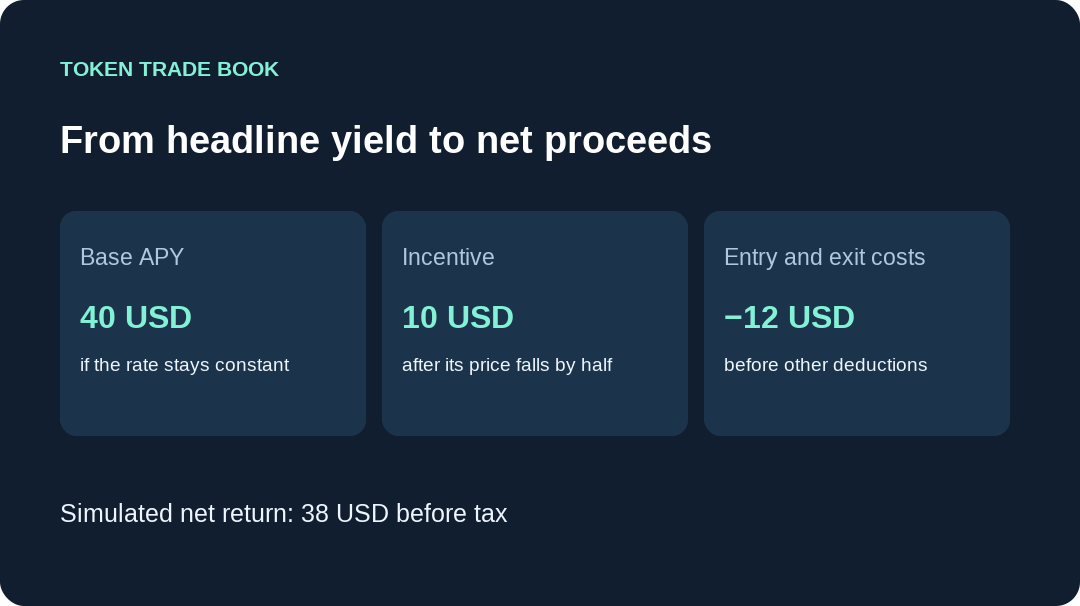
Suppose a fictional offer quotes 4% base APY and an incentive advertised as another 2 percentage points. On a $1,000 balance, the 4% would imply $40 over a year if the rate and quoted compounding held. An incentive shown as a $20 equivalent could ultimately be worth $10 if the reward token halves in price. After $12 in total entry and exit costs, that modeled outcome is $38, before taxes. A stablecoin price below its target could reduce the value further.
Test the exit before you compare rates
Find the withdrawal rules and assets you will receive. Check for lockups, queues, limits, liquidity requirements, accrued fees, and whether rewards need a separate claim. If a platform pays two rates, verify the unit, cap, eligibility, holding period, and which amount the bonus applies to. If collateral is used elsewhere, untangle that position before estimating what is available to withdraw.
Ask what could take principal down
Issuer and peg risk attach to the token. Platform insolvency, contract flaws, scarce liquidity, and forced conversion can come from the product. Holding a dollar-targeted token does not establish access to issuer redemption or bank-deposit protection. Circle's USDC terms, for example, distinguish the token and its redemption arrangement from a bank deposit and state that USDC itself pays no interest.