What is APY in crypto, and how does it differ from APR?
Annual percentage yield (APY) expresses a one-year return with an assumed compounding schedule. APR is an annualized rate quoted before compounding in the simple example below. Neither label tells you whether a rate will last, whether reinvestment is automatic, or what you can withdraw after fees.
Follow one constant-rate example
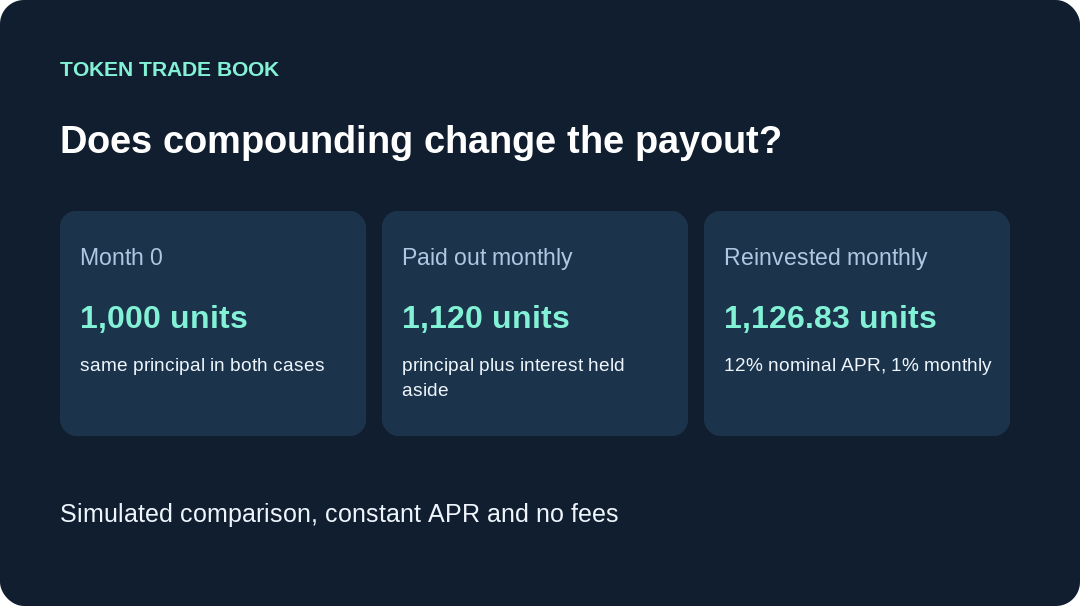
Suppose a hypothetical offer pays a constant 12% nominal APR, credits it monthly, and reinvests each credit immediately. The monthly rate is 1%. The first month grows 1,000 units to 1,010 and the second to 1,020.10. After 12 months, the balance is about 1,126.83 units. Exactly one year at that schedule turns a 12% APR into about 12.68% APY.
The equation is APY = (1 + APR / n)^n − 1 under the assumptions above, where APR is a decimal and n is the number of compounding periods per year. If the interest is paid out each month and never reinvested, the same constant-rate illustration gives 120 units of total interest rather than 126.83.
Check how the product defines its APR
Some interfaces show a backward-looking average, a live rate, a promotional maximum, or a blend of base interest and rewards. Ask what time window and balance the quote represents. A stepped or capped offer cannot be modeled by applying its highest displayed rate to the entire deposit.
See which compounding is actually possible
Check when the product credits, vests or releases the payout. Manual claims, gas charges and a reward paid in a different token may make the displayed compounding schedule impractical. A chart saying 12.68% does not make that a forecast. A variable protocol rate can move between each accrual, and rewards denominated in another token may change in value.
Compare results for your intended holding period
A one-year figure is a common comparison unit. For an intended one-month stay, estimate the amount expected to accrue in that month, subtract execution or withdrawal costs, and check the earliest exit. Compare results in the same currency. Borrowing APR and earning APY measure different sides of a transaction and should be reconciled separately.
Sources and related reading
-
CFPB APY calculation reference for savings disclosures — a mathematical reference, with separate rules for products in its regulatory scope.