Risk-reward ratio in crypto trading
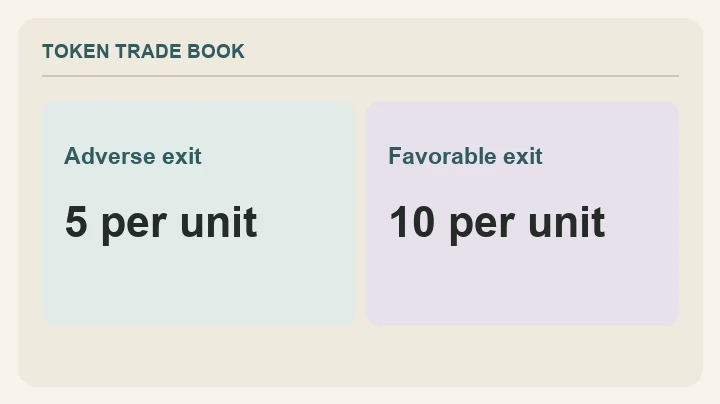
For a long entered at 100 with a stop at 95 and a target at 110, risk is 5 and potential reward is 10 per unit. That is 1:2 risk to reward before costs or slippage.
Make the notation unambiguous
For a hypothetical long at 100 with a stop at 95 and a target at 110, risk is 5 per unit and planned reward is 10. The risk-to-reward ratio is 1:2, while reward divided by risk is 2. Reverse the arithmetic directions for a short. Neither exit price is guaranteed.
Add probability and cost
If each winning trade earns exactly 10 and each loss is exactly 5, the break-even win rate before costs is 5 ÷ 15, or about 33.3%. With 1 cost per completed trade, the outcomes become +9 and −6. The new break-even rate is 6 ÷ 15, or 40%. Those numbers depend on the simplified assumptions.
Test a rule rather than a chart annotation
Record when the entry becomes possible, how exits would fill, and which result you count when both levels occur inside a candle. Track observed average winners and losers. A ratio chosen in advance differs from the realized distribution. Moving the target farther away can lower the likelihood of reaching it.
Look at the distribution, not just the setup
Two strategies can share a planned 1:2 ratio while having very different realized costs and exit behavior. In a sample journal, record the actual price difference at each exit and the round-trip charges. A few larger-than-planned losses can move the measured break-even rate even when the printed ratio stays the same.
Is a high ratio automatically better?
No. A distant target can occur less often and does not correct unfavorable fills. The ratio describes the shape of a planned trade, not its value on its own.
Educational material. Examples are hypothetical.