A risk checklist for leveraged crypto trading
A risk review starts with how much you are exposed to and what backs the position. Check what an exit could actually fill at, including what happens if price moves past your stop.
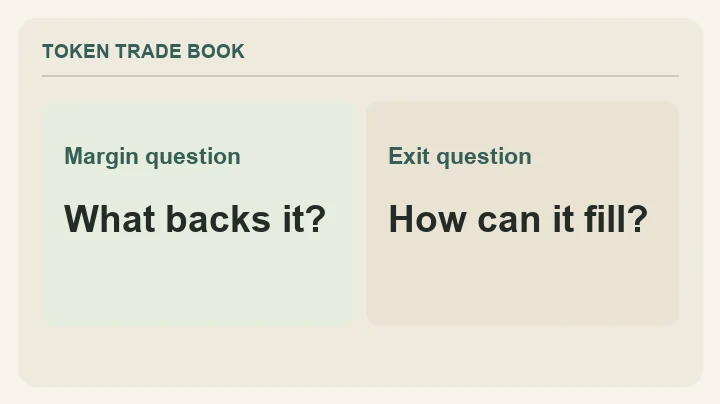
Check exposure and concentration
Write down total notional, position direction and maximum tolerable loss for the hypothetical plan. Count other positions with similar exposure. Two differently named assets can fall together. Include collateral whose value can change, because it can magnify a drawdown even while the position size is unchanged.
Check margin and execution separately
Record margin mode, maintenance requirement, mark-price convention and current estimated liquidation level. Then record exit type, trigger source and likely order-book depth. Ask what would happen if price skipped the exit level or if post-only caused the intended order never to fill.
Write the failure steps in advance
Choose a review time, a rule for when the thesis no longer applies, and an operational response for connectivity problems. Keep a paper log with the intended order and the observed fills. Afterward, compare the assumed costs with the observed spread, fees and funding.
Rehearse one failure before placing anything
For a paper plan with an exit at 95, run a second scenario where the first executable bid is 92 and the data connection drops. Document the resulting equity and the broker’s stated cancellation behavior. Compare that outcome to the worksheet limit and mark in advance which piece of information would make you abandon the example.
Why is a checklist useful without a trade?
A rehearsal can reveal missing product information. The outcome can be to postpone a decision or keep it in simulation. Completeness of the checklist does not imply the risk is acceptable.
Educational material. Examples are hypothetical.