Stop loss and take profit orders explained
A stop loss is an instruction to exit after an adverse move. A take profit exits at a chosen favorable level when its conditions are met. An order that triggers can still fill at a different price or remain unfilled.
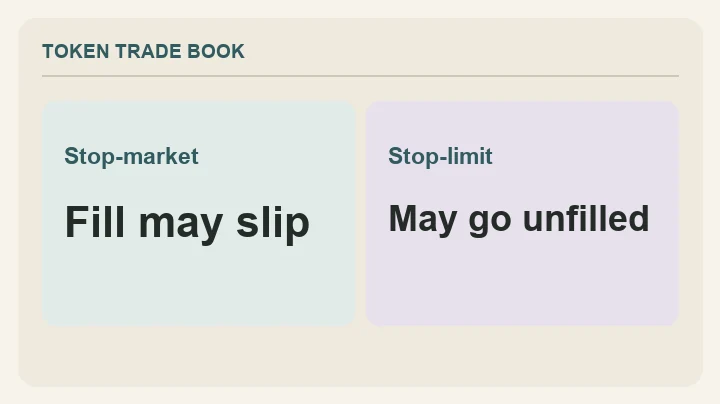
Compare trigger and execution
Consider a hypothetical long entry at 100. A stop-market exit could trigger at 95, while a take-profit limit rests at 110. If the book gaps from 96 to 92, the stop can fill near available bids below 95. A sell stop-limit with a 94 floor could trigger but stay unfilled instead.
Brackets and reduce-only
A bracket can link a stop and profit exit so that one cancels or adjusts the other. Check whether cancellation requires a full fill or can handle partial fills. A reduce-only flag on derivatives is designed to cut an existing position rather than open the opposite side. Product-specific behavior matters when several exits are live.
Set expectations before watching price
Record which price controls the trigger and what order is submitted afterward. Test what happens to the remainder at partial fill and what happens if the position was closed manually first. An exit level on a chart is a plan, while the venue’s order screen provides the contractual mechanics.
Trace a partial fill in a bracket
An example long holds four units and a take-profit order fills for one. A bracket should now have no more than three units left to protect if the product automatically adjusts the other leg. Some instructions cancel or resize differently after partial fills. Inspect the remaining quantity and linked order status after a partial fill.
Can I use either as a guarantee?
Every exit depends on execution conditions. A gap can leave no prices at the trigger, and a limit can sit unfilled.
Educational material. Examples are hypothetical.