What is liquidation in crypto trading?
A venue can forcibly reduce or close a position when the account no longer meets its margin requirement. The risk engine can act while equity remains positive and before the last traded price crosses the displayed estimate.
Follow the equity threshold
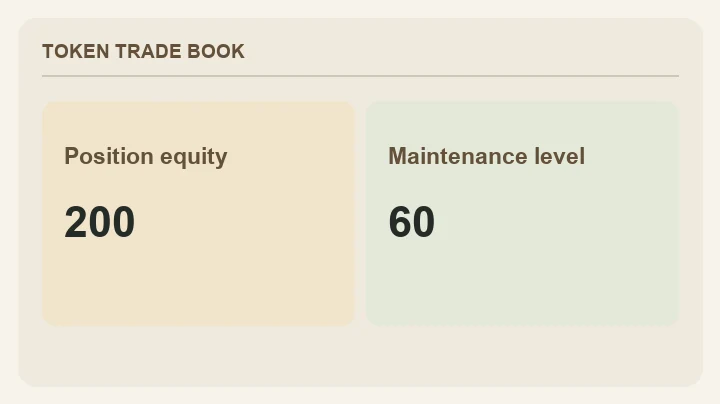
Suppose a position has 200 in equity and its maintenance requirement is 60. It starts with a 140 buffer before any changes. If its unrealized loss increases, equity shrinks. The threshold and buffer can change at the same time because the maintenance requirement, fees or other positions change.
Read the venue’s trigger
Many derivatives monitor mark price or account equity instead of simply watching the last trade on a chart. Partial liquidation may reduce exposure; full liquidation may close the position. An estimated price is not a guarantee about execution. Losses, fees and outcome depend on the contract and procedure.
Distinguish it from a voluntary stop
A stop is your instruction to send an exit when a condition is met. Liquidation is the venue’s response when its margin condition is violated. Fast changes, gaps and trigger conventions mean a stop is not a guarantee that liquidation is impossible.
Why the chart may look untouched
Imagine a liquidation estimate at 85, a last print of 85.50 and a mark of 84.90. A venue that applies a mark-based trigger could begin liquidation while a last-trade chart appears above 85. Pull the trigger reference, account history and fills for the same timestamp before inferring what happened.
What changes the buffer?
In a controlled example, changing size, collateral or margin mode can change the buffer. In real positions, risk tiers, other holdings and collateral values may move too. Always check the venue’s live estimate and account rules.
Educational material. Examples are hypothetical.