How a trailing stop loss works
A long trailing stop can move up with the price but stays put when price falls. The trigger follows the venue’s reference price and opens the exit order specified on the ticket.
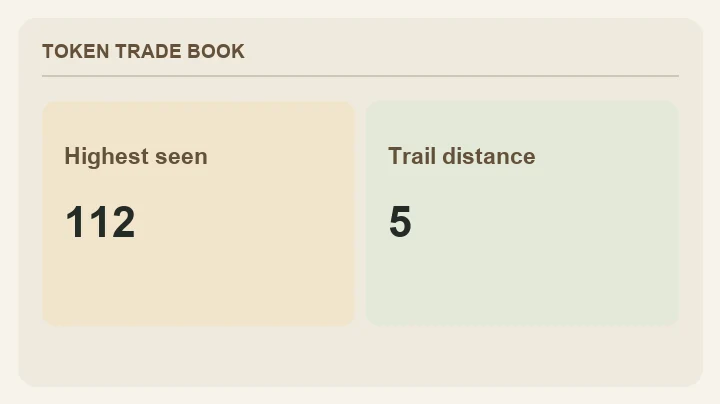
Trace a fixed-distance trail
In a numerical example, a long has a trailing distance of 5. At a reference price of 100 its initial trigger is 95. If the reference climbs to 112, the trigger rises to 107. A slide to 109 leaves the trigger at 107. A subsequent touch can activate the exit; none of these prices is a guaranteed fill.
Read three settings separately
The trailing distance can be an amount or percentage. Some venues require a separate activation price. Then check whether the trigger watches the last trade, mark or another reference. A short typically trails in the opposite direction. Platforms can round calculated levels to valid ticks.
When fixed and trailing stops differ
A fixed stop expresses a pre-set level. A trailing stop reacts to favorable movement and can tighten near short-lived price spikes. Neither approach replaces a planned loss calculation. Compare two simulated price paths with the same ending price and you can get different trigger outcomes.
Replay a percentage trail
At a peak of 120, a 5% long trail gives a trigger of 114. A later quote of 117 leaves the trigger at 114 under a simple peak-based rule. Some venues set the reference only after activation and round to the allowed tick. A paper replay shows how favorable runs affect the trigger even if two price paths end at the same quote.
Is a trailing stop an automation strategy?
It automates an exit instruction under defined conditions. It does not assess why price moved or whether the position still fits a plan, and system interruptions or gaps can affect the result.
Educational material. Examples are hypothetical.