Position sizing for crypto futures
Start with a cash loss budget. Divide it by modeled loss per contract at the planned exit. Check the contract multiplier, lot increment, costs and margin independently.
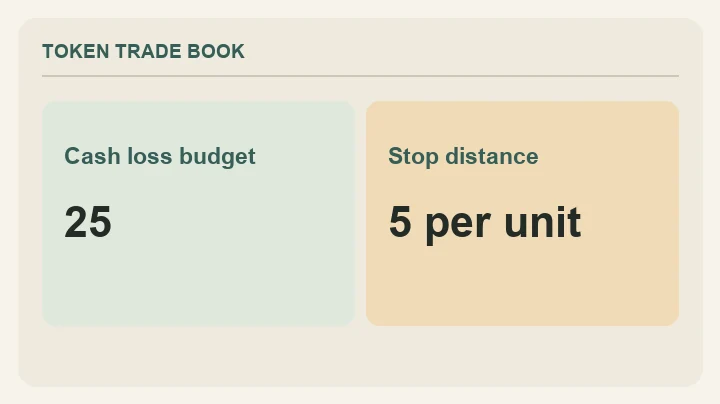
Begin with units rather than leverage
A hypothetical plan allows 25 in gross loss. Entry is 100 and the modeled exit is 95, a distance of 5 per unit. Dividing 25 by 5 gives five units before fees. The result is 500 notional at entry. It does not say how much collateral the venue requires.
Check the contract multiplier
For contracts, multiply the price difference by the amount of base exposure per contract before dividing. A contract representing 0.1 units loses 0.50 on that same 5 adverse move, so the simple model gives 50 contracts. Round downward to valid lot increments and check settlement currency.
Recalculate the loss with less favorable assumptions
An exit at 94 instead of 95 changes the loss to 30 for five units before costs. Two execution fees, plausible slippage and any holding costs reduce the budget available for the price move. A stop level is an input to the model rather than the largest loss the position can incur.
Convert units into contracts before rounding
If your example gives five base units and each contract represents 0.3 base units, the calculation gives 16.66 contracts. A whole-contract increment means 16 contracts fit inside the simplified limit, covering 4.8 units. A broker’s minimum quantity and actual cost can make the trade impossible within the worksheet’s assumptions.
How is sizing different from margin?
Sizing sets exposure. Margin sets how that exposure is collateralized. A position can fit a sizing worksheet while still conflicting with a venue’s margin or liquidation rules.
Educational material. Examples are hypothetical.