Crypto position size calculator and worked examples
Enter a hypothetical account value, risk percentage, entry and stop. The calculator divides the cash risk budget by the price distance and reports the number of linear units before costs.
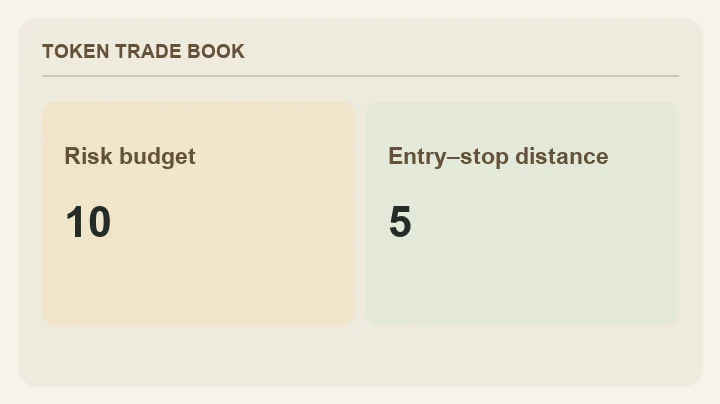
Enter a hypothetical scenario
With 1,000 of account equity and a 1% example risk allowance, the model starts with 10 cash risk. At entry 100 and stop 95, the price distance is 5. The result is two units and 200 notional before fees. The calculator uses the same distance for a short with entry 100 and stop 105.
Explain the assumptions behind the result
The tool assumes a linear instrument with one base unit per output unit and an exit exactly at the entered stop. It leaves funding, fees, gaps and slippage out. A zero distance is undefined. The tool rejects a stop on the wrong side of the hypothetical entry, so the direction is clear.
Apply venue units outside the calculator
Check whether a contract represents a fraction or multiple of one base unit. Exchange quantity steps can require rounding down. Margin requirement, liquidation price and funding are separate calculations. If an apparent result cannot be expressed at the venue’s minimum quantity, do not round it up and call it the same risk.
What to do with the number on screen
Express the result in the exchange’s supported quantity step and round down before repeating the loss estimate. If a worksheet gives 2.03 units and only tenths are supported, use 2.0 for that comparison. Check contract multipliers separately. The simplified tool cannot model variable margin requirements or a worse exit fill.
Is the output a recommendation?
The result follows mechanically from the inputs. A calculated amount can still be unsuitable, and execution losses can exceed the modeled amount.
Educational material. Examples are hypothetical.