What is a stablecoin depeg? How to read a price away from $1
A stablecoin depeg is a departure from the price the token aims to track. For a dollar-pegged token, this means a price below or above $1. There is no universal threshold that distinguishes a depeg from ordinary price noise. Record the distance from the peg, the time and place of the quote, the size available and whether the price appears on other liquid venues.
Check what the quote measures
- Verify the pair. USDC/USD and USDC/USDT answer different questions. A deviation in USDC/USDT can reflect a move in either token.
- Check the type of price. A last trade can be stale, tiny or isolated. For an immediate sale, inspect the bid and the amount you can sell at each level.
- Compare other liquid venues and the exact token representation. A bridged token can have a local liquidity or bridge problem even if the native version trades closer to target.
- Separate the market price from your exit. Check account eligibility, redemptions, transfer status and withdrawal conditions independently.
Worked example: which number applies to 1,000 tokens?
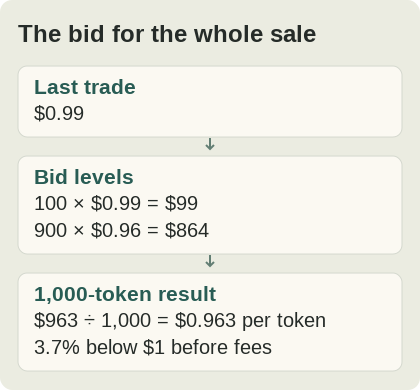
A fictional venue has a last trade at $0.99. It bids $0.99 for 100 tokens and $0.96 for the next 900. A marketable sale against unchanged depth would yield $99 plus $864, or $963 before fees. Its average execution price would be $0.963. That is a 3.7% discount to $1 for this sale. The displayed last trade alone would imply a 1% discount. If you see another venue near $1, check whether you can reach it in time and whether its quotes cover your size before assuming the prices are interchangeable.
A real example: USDC and Silicon Valley Bank
In March 2023, Circle reported that $3.3 billion of its reserve deposits, about 8% of the reserve at the time, were held at Silicon Valley Bank. USDC temporarily traded below its target. U.S. authorities subsequently announced that depositors would have access to their funds, and Circle reported that the gap to the dollar closed. That episode illustrates how concerns about access to part of the backing can affect trades even when the issuer still states a $1 target. It does not establish that a future deviation will resolve the same way.
Circle’s March 2023 statement · March 12 Treasury, Federal Reserve and FDIC statement
Reserve access, collateral valuation, failed hedges, impaired cash routes and thin markets affect different tokens in different ways. Start with the issuer’s current disclosures and the executable market you can actually use. A discount that looks like a quick arbitrage can persist when your account cannot redeem or when a transfer stalls.
Read next: order-book depth or how slippage works.