How to read a crypto liquidation heatmap
A liquidation heatmap shows where a provider’s model estimates forced closures could cluster. Read the price axis, time window and color scale before comparing bands with reported liquidations.
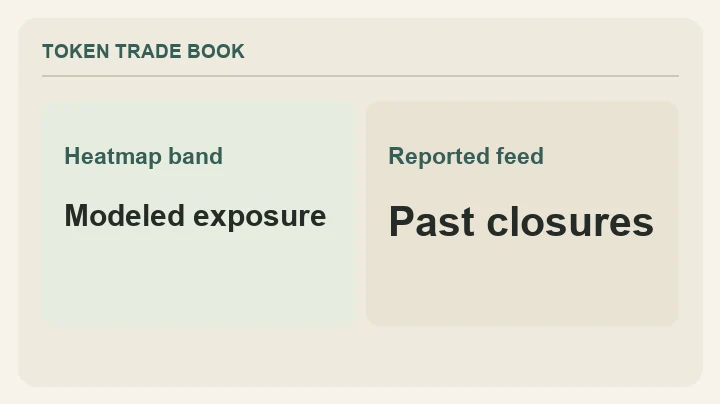
Read the axes and the colors
On a typical heatmap, time runs across the chart and price runs vertically. More intense colors represent a higher modeled concentration under that provider’s scale. Check whether colors are normalized per window or model. Comparing a bright patch on a short window with a dim patch on a long window can be meaningless.
Distinguish estimates from reports
The chart provider may infer liquidation zones from pricing, size and assumed leverage. The data cannot generally reveal every trader’s collateral settings. A historical liquidations feed is different: it tracks reported events that already occurred, with its own coverage gaps.
A simple observation exercise
Pick one symbol and time range. Note where a band appears relative to current price, then compare the subsequent path with reported liquidations on the same venue. Log misses as well as hits, including bands that vanish or move. Treat this as a check on interpretation, not a price forecast.
Take a snapshot before comparing a band with events
Record the exchange or aggregate, symbol, time window and color scale when a band appears. Later, compare it with a feed of reported liquidations for the same coverage. An unmatched bright band can come from the model assumptions, a change in positions or a price path that never reached the zone.
Can a bright band predict a move?
It indicates where the model estimates more potential liquidations if price gets there. It does not establish that price will reach that level, or how it will react if it does.
Educational material. Examples are hypothetical.