How does crypto futures trading turn a price move into P&L?
Crypto futures give you contractual exposure to a cryptocurrency price. To understand what a move means for an account, identify the contract multiplier, quote and settlement currency, margin rules, and whether the contract expires or uses a funding mechanism. Two tickets labeled BTC can behave differently when those terms change.
Read the contract before the chart
| Ticket field | Question it answers |
|---|---|
| Underlying and contract multiplier | How much price exposure does one contract represent? |
| Linear or inverse payout | Which units does the P&L calculation use? |
| Expiry or perpetual | Does the contract end on a set day, or is there a funding process to track? |
| Collateral and settlement asset | What backs the trade, and where do gains or losses appear? |
| Initial and maintenance margin | What does the venue require at entry and while the position remains open? |
| Mark or other reference price | Which price drives valuation, margin or liquidation? |
A dated contract specifies expiry and settlement. A perpetual contract typically uses funding to manage the relationship to its underlying reference without ordinary dated expiry. Check the actual specifications. A spot quote and a derivative price can differ because they are distinct markets.
Reconcile one simulated trade
Model one linear contract representing 0.1 units of an asset at $50,000 per unit. The initial notional is $5,000. If the contract price rises to $51,000 and a long position closes at that price, gross trade P&L is ($51,000 − $50,000) × 0.1 = $100. The short side of the same price move has a $100 gross loss on the corresponding exposure.
Now assume the exercise has $1,000 of initial margin. The same $100 gross result represents 2% of initial notional and 10% of initial margin. A price move is still the same dollar move for the same position size. Changing margin changes the denominator and can change how close the position sits to its maintenance threshold.
Separate the three ledger entries in a perpetual
- Trade P&L comes from entry and exit prices and the contract payout.
- Fees depend on the cost of executions and any other charges the product discloses.
- Funding or settlement cash flows follow the product schedule and specifications. For a perpetual, a positive funding rate can mean longs pay shorts on a given venue. Consult the funding history and sign convention.
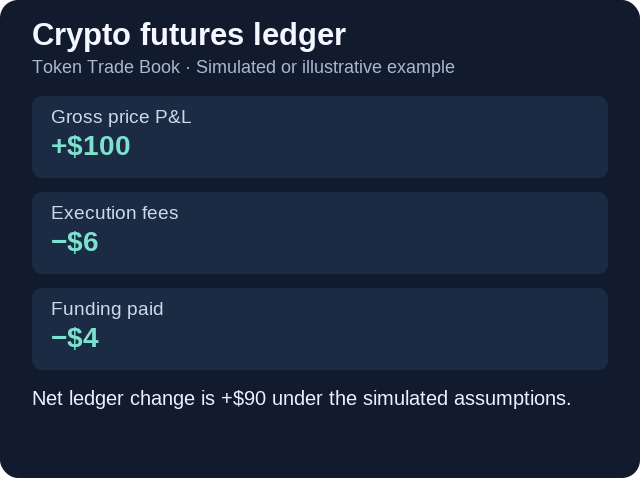
In an exercise where the position earns $100, fees total $6, and the account pays $4 in funding, the net change from those entries is $90. If the collateral asset also changes value, account equity measured in another currency can move further.
Where does liquidation enter the picture?
A venue can intervene while a trade is open if its maintenance requirement is breached. A chart’s last trade may differ from the reference the venue uses for monitoring margin. Margin mode and other positions can also affect the threshold. For a specific case, use the contract's documentation, relevant price feed and account event history. The liquidation guide walks through that distinction.
For the daily settlement of a dated contract, see futures trading from entry to settlement. This example uses a simplified linear payout. Inverse contracts or products with different lot conventions and fees require their own written formula. Compare spot and perpetual futures before carrying any assumption from one ticket to the other.