Spot vs. perpetual futures in crypto
Spot gives you ownership of the asset after the trade. A perpetual gives you contractual exposure. Compare equal position sizes, then account for custody, periodic funding and liquidation.
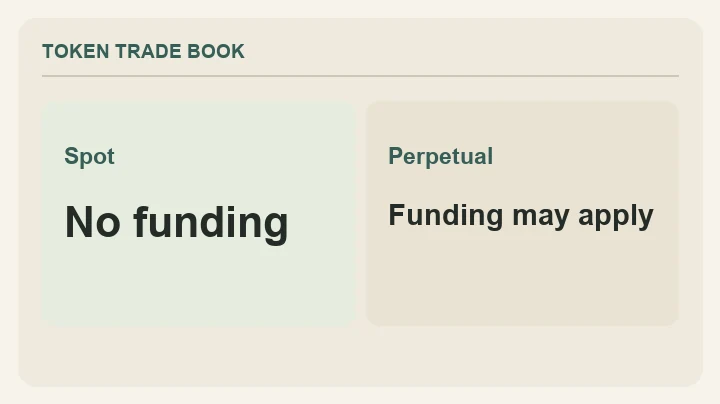
Compare equivalent exposure
In a simplified example, an unborrowed spot purchase of one unit at 100 and a linear perpetual long with a one-unit exposure both gain 5 if the relevant price goes to 105 before costs. The perpetual might require less than 100 in posted margin, but it still has the full one-unit exposure. A 5 loss can therefore be a much larger share of posted margin.
Where the paths diverge
Spot custody determines what you own and how you can withdraw it. A perpetual is settled through the venue and may have recurring funding. Even if price later recovers, a margined position can be closed first. A spot position funded by borrowing adds separate interest and margin risks.
Match the comparison to the question
To compare costs, hold notional and time horizon fixed, then list trading fees, spread, funding and any borrowing costs. To compare risk, list margin mode, mark-price rules, liquidation threshold, custody and venue exposure. Comparing margin posted with spot purchase cost alone is misleading.
Compare the same move and holding interval
At 100 entry and 105 exit, both illustrative one-unit positions gain 5 gross. If the perpetual pays 0.10 in funding during the window, its result before trading fees is 4.90. If it receives 0.10 instead, that figure is 5.10. The spot example has no perpetual funding. Keep execution and custody costs separate from that comparison.
Can spot ever short?
Unborrowed ownership by itself cannot provide short exposure. Some venues allow a borrowed asset to be sold and repurchased, subject to borrow cost, availability and margin rules.
Educational material. Examples are hypothetical.