How does futures trading work from entry to settlement?
A futures contract specifies exposure to an underlying asset or benchmark and the terms for settlement. On a standardized exchange-traded contract, one contract has a defined multiplier, settlement process and expiry calendar. Margin is collateral against the resulting obligation. It is much smaller than full notional on many products, so a price change can have a large effect relative to the margin posted.
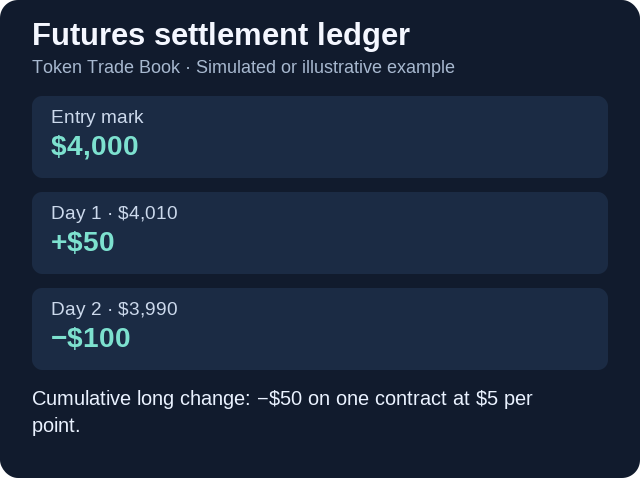
Follow an example across two settlement marks
Suppose a hypothetical cash-settled contract is quoted at $4,000 and pays $5 for each one-point move. The contract notional at entry is $20,000. If the first settlement price is $4,010, the long side gains $50 and the short side loses $50. If the next settlement price is $3,990, the long side loses $100 from the previous settlement and the short gains $100. Across both days, the long has a $50 gross loss from entry.
| Event | Settlement mark | Long change from previous mark | Cumulative long result |
|---|---|---|---|
| Enter one contract | $4,000 | — | $0 |
| Day one | $4,010 | +$50 | +$50 |
| Day two | $3,990 | −$100 | −$50 |
This exercise assumes one linear contract, no fees and variation settlement against the listed marks. A daily settlement calculation is different from the price at which you can choose to close: closing requires a matching execution, whose price appears in your trade report.
Use the contract spec to answer five questions
- How large is it? Multiply the quoted price by the contract multiplier using the contract's units. Find the minimum price increment and its dollar value.
- When does it end? Look for last trade date, expiry and settlement reference. These dates can serve different purposes.
- How does it settle? Cash settlement and physical delivery create different obligations. Read the rules before assuming you can hold through expiry.
- What collateral is needed? Exchange requirements, broker add-ons and intraday policies can vary. Margin can be raised while a contract is open.
- When does P&L affect the account? Check the marking and variation settlement process, as well as margin call or forced-close rules.
Why trade a future instead of holding the asset?
A hedge offsets some price exposure elsewhere. It can still have basis risk if the hedge instrument and actual exposure move differently. Speculation seeks standalone exposure to a price move. Both use similar tickets and settlement rules, but success should be evaluated against the stated objective. A hedge can lose on its futures leg while reducing the combined loss elsewhere.
If you arrived from a crypto perpetual, start with the expiry and funding fields. An ordinary dated futures contract has a final settlement process. A perpetual product can have different rules. Our crypto futures guide shows what to check when the underlying is a crypto asset.