What is USDT? How Tether’s dollar token works
USDT is a token issued by Tether that aims to trade at one U.S. dollar. You can hold it in a compatible wallet or trade it through an exchange. On an exchange, the quoted price can move above or below $1, and actually turning USDT into cash depends on where you hold it and what exit routes you can use.
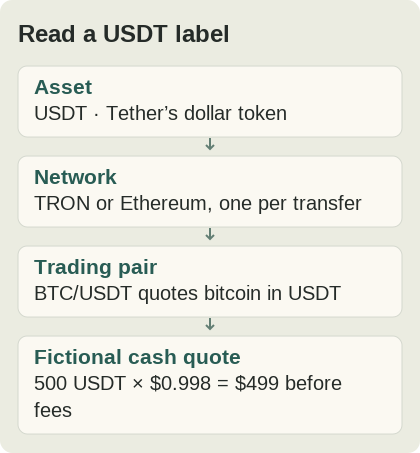
One ticker, three things to identify
Issuer: Tether publishes reports about the reserves backing the tokens it issues. The reserve is a pool of assets, with the composition disclosed in dated reports. The ticker on a trading screen does not give you ownership of a particular dollar or Treasury bill in that pool.
Network: Tether issues the token on more than one blockchain. A USDT balance on Ethereum and one on TRON are separate sets of on-chain records. An asset transfer within one network does not transfer that balance to another network.
Trading pair: A pair like BTC/USDT quotes the price of one bitcoin in USDT. At 60,000 USDT per BTC, buying 0.01 BTC costs 600 USDT before fees. The exchange is quoting in tokens. Valuing that receipt in bank dollars requires a separate USDT/USD price or an actual cash conversion.
What Tether reports about USD₮ · Tether’s reserve reports · Tether’s supported networks
What happens to 500 USDT if the quote moves?
Suppose the executable USDT/USD bid for your full amount is $0.998, and the venue charges a $1 cash withdrawal fee. In this simplified example, selling 500 USDT yields $499 before fees, and cashing it out yields $498. This assumes no separate trading fee and a usable bank withdrawal route. The token balance has stayed at 500 USDT throughout the price change. Its cash value and your net proceeds are different amounts.
A retail user often sells through a supported exchange and withdraws fiat there. Direct redemption is a separate service that requires meeting the issuer’s terms and eligibility requirements. Tether publishes its own minimum and fee schedule. Check the actual exit available to you before treating a $1 reference price as an amount you can withdraw.
Tether legal terms · Tether’s primary-market fees
If someone asks you to use USDT in Telegram
“Wallet in Telegram” can refer to different services. Walt, formerly Wallet, offers a custodial balance and a separate self-custody DeFi Account on TON. Its help center also distinguishes Walt from Telegram’s own Money wallet. Identify the exact product and account before using a deposit address. Open its official receive screen and check the USDT network and minimum there. A Telegram username alone does not tell you which on-chain route the recipient can use.
Walt’s explanation of its Telegram product and account types · Walt deposit instructions
What to check before using USDT
- If you want to trade, confirm that the market you need is quoted in USDT and check its bid, ask and available size.
- If you want to transfer, get the recipient’s exact token and network instructions before opening the withdrawal form.
- If you want cash, check the fiat exit, the provider’s fees and any restrictions on withdrawals.
- If you received an unsolicited token, verify its contract against the issuer’s listing for that network. A displayed symbol alone cannot identify the token.
Read next about sending USDT, USDT on TRON or the difference between USD and USDT.