USD vs USDT: A dollar, an exchange balance and a token
USD is the currency of the United States. USDT is Tether’s blockchain token designed to trade near one USD. Which one you have determines where you can send it, what you can withdraw to a bank and which rules govern your balance.
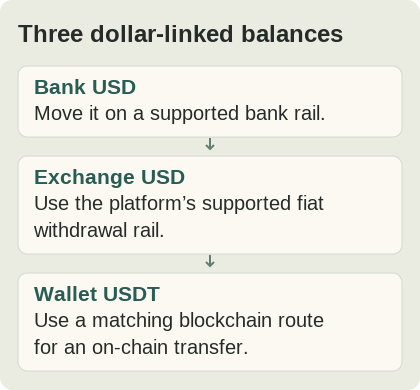
| When a screen says… | What you may hold | A typical way out |
|---|---|---|
| USD at a bank | A deposit owed to you by your bank | A supported bank transfer or withdrawal |
| USD at a trading platform | A platform fiat balance whose custody terms can vary | A supported fiat withdrawal under that provider’s rules |
| USDT in a wallet | A blockchain token on one specific network | An on-chain transfer to a compatible recipient or a sale through a venue |
Deposit protection depends on the jurisdiction, institution, account and eligibility. In the United States, FDIC insurance concerns eligible deposits at insured banks. A USDT token does not become a bank deposit merely because it references the dollar. Read the provider’s custody disclosures for an exchange USD balance to understand where the funds are held and which protections may apply.
FDIC’s deposit insurance information · Tether’s description of USD₮
Read the destination before you choose
A bank beneficiary supplies bank payment details. A supported blockchain recipient gives you a chain-specific address and sometimes a tag or memo. Sending USDT to a blockchain address cannot complete a request for a bank wire. To pay it using value you currently hold in USDT, first check your options for converting and withdrawing USD, including account eligibility.
If a deposit form says USD, open it and see which rails it accepts. If it says USDT, confirm the network and withdrawal or deposit support. Giving both balances a dollar-value column in the same portfolio screen does not make their rails interchangeable.
Worked example: converting 1,000 USDT before a cash withdrawal
Your venue hypothetically bids $0.996 per USDT on the full quantity. A sale yields $996 before costs. If the venue deducts a $1 conversion fee and $2 cash withdrawal fee, you receive $993 under those assumptions. A $1-per-token portfolio estimate would show $1,000. The $7 difference is $4 from execution versus $1 and $3 in fees.
That calculation represents a secondary sale at the provided quote. Direct issuer redemption has different terms, eligibility, minimums and fees. It is possible for an on-screen quote to be near $1 while the only cash route available to your account delivers less.
Tether’s direct minimums and fees · Tether legal terms
Read next: What is USDT? or How to evaluate USDT risks.