Is USDT safe? How to check the risks behind the $1 target
USDT can trade close to $1 while still exposing you to issuer, liquidity, custody and transfer risk. First identify what you need to work. Holding a small balance for a trade, sending a payment to another network and relying on a large balance for a cash withdrawal each require different checks.
| Risk | What can happen | Where to check |
|---|---|---|
| Reserves | Changes in the value or liquidity of reserve assets affect the resources available to the issuer | Latest dated reports, reserve categories and accountant’s scope |
| Market price | The available USDT/USD bid can fall below $1 or have insufficient size | Executable quotes and order book on your venue |
| Redemption access | Your account may be ineligible for direct redemption or bank withdrawals | Issuer terms and account-specific conditions on your cash exit |
| Custody | A platform holding your tokens can suspend withdrawals | Provider status, custody disclosures and account restrictions |
| Issuer controls | Tether can restrict access, freeze tokens or exercise other rights under applicable terms | The relevant issuer terms and public notices |
| Transfer | A wrong address, network or token contract can leave funds inaccessible | Receiver’s deposit instructions and official chain documentation |
Tether reserve disclosures · Tether legal terms · Tether’s direct minimums and fees
Separate a reserve report from a promise about your balance
Look at the date of the report and the accountant’s description of the engagement. Read the assets and liabilities before using any asset headline. A report for a specific date cannot establish that the next sell order on your venue will fill near $1. It cannot establish that your own withdrawal request qualifies, either.
The published terms and fee page govern direct issuer access. Secondary conversion depends on a third party’s execution, custody and fiat withdrawal rules. An issuer reporting enough reserve assets and an intermediary delaying withdrawals are two conditions that can occur at the same time.
Worked example: spot price looks stable, but withdrawals are paused
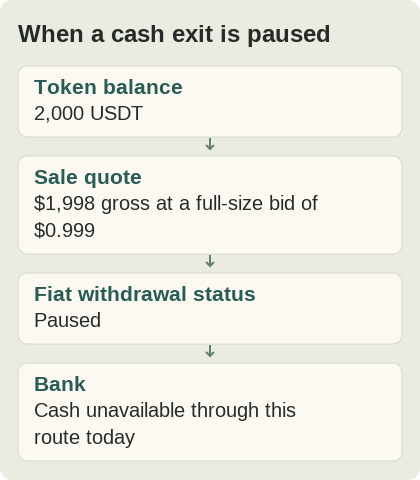
Imagine a venue displays an executable bid of $0.999 for your whole 2,000 USDT balance. The hypothetical gross sale proceeds are $1,998. The venue has paused fiat withdrawals. The quoted sale price still describes a potential execution on that trading account, but even an executed sale would produce a balance on the venue rather than cash in your bank today. Check whether the relevant crypto withdrawal route is available before assuming that you have a second exit.
If the same venue displays $1.000 as the last trade but offers bids only for small amounts near that price, the cash you could actually realize would depend on the lower order-book levels needed to sell the full position.
A practical check
Write down where you hold the token, which confirmed network can move it, what venue can convert the required size, and where you can withdraw the proceeds. Check these four items independently. When reviewing a transfer, get the address from the recipient and confirm the chain and contract through trusted sources. A mistake at this step cannot be made safe by a stronger reserve report.
Read next: USD vs USDT and how depegs change execution.