What is TRC-20? What “USDT TRC20” means on a withdrawal screen
TRC-20 is a token standard on the TRON blockchain. “USDT TRC20” means a version of Tether’s dollar token carried on TRON. If an exchange labels its withdrawal route “TRON (TRC20)”, you need the recipient to explicitly accept USDT over TRON.
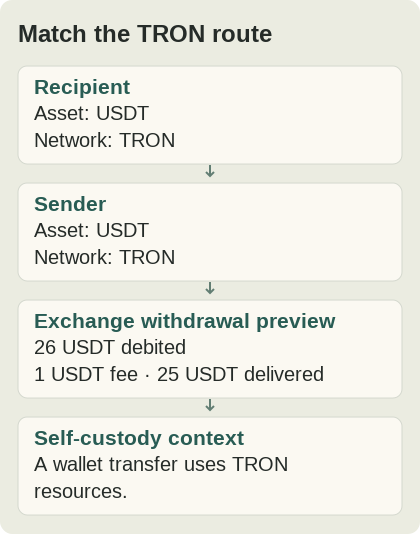
Read the asset and the network separately
The asset field says what you are sending. The network field says where the sending service will record it. USDT is the asset. TRON is the network. TRC-20 describes how the token contract exposes functions such as balance checks and transfers.
An Ethereum ERC-20 token and a TRON TRC-20 token may expose similar contract functions. Their balances live on separate networks. Choosing ERC-20 because a service lists “USDT” nearby will use Ethereum if the form’s selected network is Ethereum. It cannot complete the recipient’s TRON deposit request.
TRON’s TRC-20 specification · Tether’s supported protocols
Match the label you see on both sides
| Example route label | What it names |
|---|---|
| TRON (TRC20) | USDT on TRON |
| Ethereum (ERC20) | USDT on Ethereum |
| BNB Smart Chain (BEP20) | A BNB Smart Chain route, if your provider supports that version |
| TON | A USDT jetton route on TON |
| Solana (SPL) | A token route on Solana |
The examples describe labels, not a list of supported deposits for any one venue. “BEP20” does not establish whether a version is issued by Tether or provided through another mechanism. Check the provider’s exact version and current issuer or contract information before using it. Two Ethereum-compatible chains can display similarly formatted addresses and still record transfers on separate ledgers.
Worked example: send 25 USDT over TRON
Suppose your recipient opens the deposit screen and selects USDT → TRON. It displays a deposit address and a hypothetical 10 USDT minimum. Your sending exchange offers the same network and shows a review screen with 26 USDT debit, 1 USDT withdrawal charge, and 25 USDT to receive. Check the network, destination address and net amount against the deposit screen. A smaller test is only useful when the net test amount still meets the recipient’s minimum.
The exchange can charge you a fee in USDT even though TRON accounts for transaction resources differently. On a self-custody wallet, a TRC-20 transfer needs Bandwidth and Energy. A wallet may consume available resources or spend TRX when resources are insufficient. The exact resource use and the displayed provider fee can change. Use the current preview rather than a fee quoted in a past tutorial.
What to look for after sending
Copy the transaction ID once the sender has published it. In an explorer for TRON, check the status, token contract, destination and transferred amount. A successful on-chain transfer and a deposit appearing in an exchange account are separate milestones. The receiving exchange may require confirmations or a deposit review before it credits the account.
If TRON is missing from either endpoint’s supported options, stop and choose a network both sides explicitly support. If the asset has already been sent on the wrong route, contact the receiving provider with the transaction ID and network details. Recovery depends on who controls the address and what the provider supports. Never share recovery words or private keys.
Read next: How to send USDT, USDT on TON, or USDT on Solana.