USDC vs USDT: What changes when you switch stablecoins?
Circle issues USDC and Tether issues USDT. Both aim to trade at one U.S. dollar, but you cannot substitute one for the other on a deposit form. Compare the exact asset and network the recipient supports first. Then compare the cost to deliver it, the reserves and terms behind it, and how you can convert the remaining balance back to dollars.
| Question | USDC | USDT |
|---|---|---|
| Who issues it? | Circle | Tether |
| Where do I check the reserve? | Circle’s transparency page and dated reserve reports | Tether’s transparency page and dated reserve reports |
| Can any holder redeem directly? | Circle Mint access is subject to eligibility and terms | Tether direct access is subject to verification, eligibility, minimums and fees |
| Which version will be credited? | The exact USDC issuance or bridged variant the receiver supports | The exact USDT network and token the receiver supports |
Circle lists where it issues native USDC. Tether publishes its supported protocols. Issuer availability and exchange deposit support are separate questions. Use the actual deposit form and official token contract information where relevant.
Circle transparency · Circle’s USDC terms · Circle native USDC contracts · Tether reserve reports · Tether legal terms · Tether supported protocols
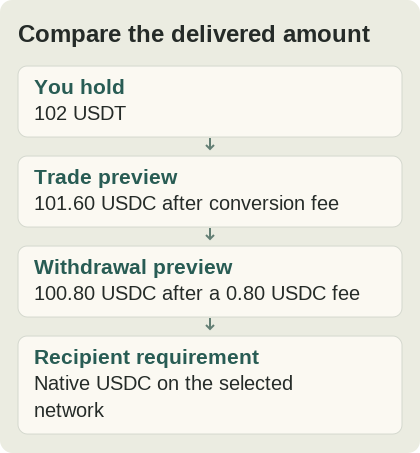
Worked example: the recipient asked for 100 USDC
The recipient says they accept native USDC on a particular network. You hold 102 USDT on a sending platform. A fictional trade preview gives you 101.60 USDC after the conversion fee. The withdrawal preview deducts 0.80 USDC and shows a net delivery of 100.80 USDC. If the platform also offers a separate amount to receive field, you could enter exactly 100 USDC and check the total debit on a new preview. In the preview above, the net delivery is 100.80 USDC.
Sending 100 USDT instead would not satisfy those instructions, even if USDT and USDC cost the same and share a network. If the recipient accepts either asset, compare the quotes for delivering the same final amount. The swap quote, withdrawal charge and deposit minimum matter more than the difference between two last-traded token prices.
How to compare reserves and exit routes
Open each issuer’s latest dated report. Compare the reporting dates and the assets included, then read the outside accountant’s report to see what data it covers. A reserve asset snapshot cannot tell you how much you can sell on your exchange in five minutes. For that, check a current executable quote for your order size and whether a cash withdrawal is available to your account.
If your priority is reducing operational complexity, write down the path you can actually use: custody account or wallet, supported sale venue, eligible fiat withdrawal, final bank destination. Check it for each token. Different available networks or cash exits can matter even when both market prices are close to $1.
Read next about USDC, USDT or how to send USDT.