What does USDC mean? A guide to Circle’s dollar token
USDC stands for USD Coin. It is a stablecoin issued by Circle that aims to maintain a value of one U.S. dollar per token. A USDC balance in a wallet shows how many tokens that address controls. Selling those tokens or redeeming them for bank dollars is a separate step.
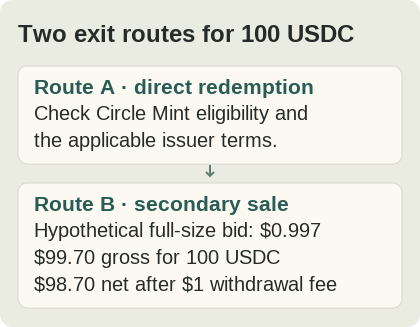
How dollars and tokens move
Circle offers direct issuance and redemption through Circle Mint for eligible customers under its terms. A holder who uses an exchange will usually work through a different route. The exchange can match a USDC sale or offer a conversion for fiat, with its own quote, settlement rules and withdrawal method. Review how the specific platform handles fees and cash withdrawals.
Circle publishes information about reserves and dated attestations. The backing includes dollar-denominated assets such as cash and short-term U.S. government exposure according to its disclosures. Read the latest report if you need the exact composition and report date.
Circle’s USDC overview · Circle transparency · Circle’s USDC terms
Worked example: two ways to exit 100 USDC
- An eligible issuer customer checks the redemption terms and current service availability. The amount referenced by the issuer is one U.S. dollar per USDC, subject to those terms and applicable conditions.
- A wallet holder checks a venue’s executable quote. In a simulated example, the venue offers $0.997 per USDC for the full order and charges a $1 withdrawal fee. Selling 100 USDC yields $99.70 before the cash withdrawal fee and $98.70 after it, with no separate trading fee in this scenario.
The issuer terms and the executable market quote answer different questions. Keep both separate when evaluating a stablecoin.
Verify the network and token before accepting a deposit
A wallet can show two assets with similar symbols. One may be native USDC issued by Circle on that chain. The other may be a bridged representation issued by another party or bridge contract. Support for one version cannot establish support for both. Open the receiver’s instructions, find the accepted network and token version, and compare the contract identifier with the relevant primary listing. The wallet screen’s label is just one clue.
Circle’s native USDC contract addresses
If you expected native USDC but see another token, leave it untouched until you can confirm the contract. Unsolicited tokens can copy a familiar name. An exchange deposit form may also have a distinct minimum and confirmation requirement even when the chain shows the transfer succeeded.
Read next: USDC vs USDT or what a stablecoin depeg looks like.