What is position trading in crypto?
Position trading means holding a trade to follow a longer-running thesis, usually over weeks or months. A position plan says what evidence would keep it open, when to review that evidence, and which costs or risks change while it remains open.
Separate the thesis from a price update
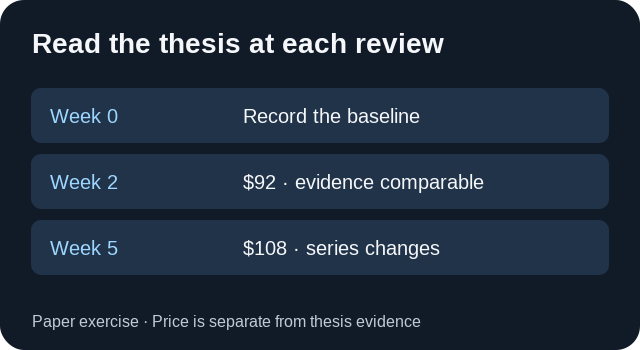
In an eight-week paper exercise, suppose a trader is testing the claim that a hypothetical asset's usage is improving. The trader chooses a public metric before entering, records how the metric is defined, and writes a weekly review rule. A price jump by itself does not verify the claim. If the measurement stops being comparable, the planned evidence is unavailable.
| Review | Price | Thesis evidence | Paper decision |
|---|---|---|---|
| Week 0 | $100 | Record a baseline and definition | Open one paper unit |
| Week 2 | $92 | Published metric is comparable and above baseline | Apply the separate risk limit and record the move |
| Week 5 | $108 | Data provider changes its method, breaking the series | Mark the evidence unavailable under the predefined rule |
| Week 8 | — | Review window expires if still open | Record the decision without extending it retrospectively |
A position can close before its thesis review. A separate loss rule handles that decision. A weekly review is also separate from the availability of orders or access to funds.
Compare spot and perpetual exposure
A fully paid spot position has no perpetual funding. A long linear perpetual can pay or receive funding at applicable settlement times. Suppose a constant $100 notional paid 0.01% every eight hours for 30 days. That would be 90 × $0.01, or $0.90, before fees and changes in notional. This constant rate and interval are exercise inputs. A real contract can change its rate, settlement timing, and margin treatment. See the funding-rate worked example and spot vs. perpetual futures.
Try it
Write a single sentence that would invalidate your paper thesis. Add a review date, an independent loss rule, and the records required to calculate costs. Compare it with a swing plan that ends when a shorter move or deadline is reached.
Sources: Coinbase Global Derivatives funding specifications, Coinbase Advanced fees.