What is swing trading in crypto?
Swing trading means holding a position to capture one part of a price move, often over several days to weeks. In crypto, the market can move while you sleep, so a paper swing plan needs an observation schedule, a rule for abandoning the idea, and an estimate of execution cost.
Follow a four-day paper swing
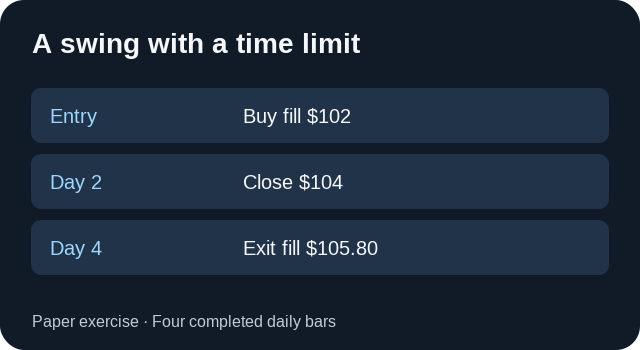
Assume a spot pair quoted in dollars, no borrowing, and one unit. After a daily close at $101.50, the exercise tests a move toward $109. The idea expires after four completed daily candles, or sooner if a daily candle closes below $96. The timing rule is separate from any order sent to an exchange.
| Event | Observation | What the paper trader records |
|---|---|---|
| Entry | Paper market buy fills at $102 | Use the fill, not the earlier chart close, in the ledger |
| Day 2 | Price reaches $107, closes at $104 | The idea is still within its stated window |
| Day 4 | The close is $106 and the target never trades | Time expires. Model a sale at $105.80 |
Gross P&L is $3.80. At a hypothetical 0.10% fee per side, the two fees are $0.1020 and $0.1058. Net P&L is $3.5922 before rounding. The model prices already represent the fills, so deducting an additional spread would count part of the cost twice.
Decide how the plan can end
A close-based rule can leave a position exposed between decisions. A separate stop order can act before the next chart review, but its trigger and execution follow the venue's rules. A stop-market order can fill farther from its trigger than expected. A stop-limit can trigger and remain open. Read the order-type example before assigning an exact exit price to either one.
Swing and position trades can both use daily charts. The difference in this exercise is the decision horizon. A swing plan expires after the move or time window it was built to test. A position trade normally reevaluates a longer-running thesis.
Try it
On a blank chart, write the setup before revealing the next four candles. Record the first event that ends it, the modeled fill, both fees, and which inputs were known at the time. If you cannot model a fill from the available data, label the outcome uncertain.
Sources: Coinbase Advanced order behavior, Coinbase Advanced fee mechanics.