How does shorting crypto work, and what would you owe to close?
A short position benefits from a falling price before costs under a simple linear example. What happens after a rise depends on the instrument. In a spot margin short, you may have to return borrowed units. A short future has contract settlement and margin rules. A purchased put has its own payoff and premium. Start by identifying which obligation you are modeling.
Compare closing obligations
| Structure | What remains open | How the exercise measures a close |
|---|---|---|
| Spot margin short | Asset or margin extension to repay, plus fees as stated by the provider | Buy to close or settle the amount due under the venue rules |
| Short linear perpetual | Contract exposure, collateral and potential funding payments | Offset outstanding contract exposure and reconcile funding, fees and P&L |
| Short dated future | Contract exposure with expiry and settlement terms | Offset before expiry or account for the product’s settlement rule |
| Purchased put | A purchased right on stated terms, with premium already paid | Sell or settle the option under its specifications, or let it expire |
Selling a coin you already own reduces your long exposure. It does not by itself create the obligation of a spot margin short. On Kraken, for example, a spot margin short opens with a sell, and the resulting extension remains repayable through settlement or closing transactions under the product's rules.
Reconcile the same price move in two examples
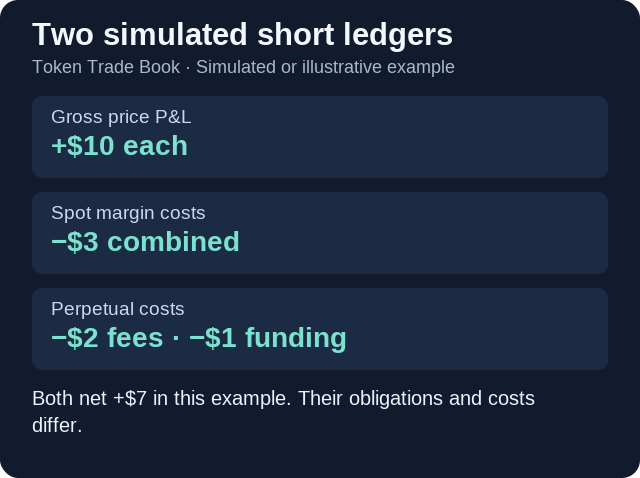
For a hypothetical spot margin short, sell one borrowed unit at $100 and buy one unit back at $90. Gross price P&L is $10. If the combined borrowing and trade costs are $3, the example nets $7. If the repurchase costs $120, gross price P&L is a $20 loss before costs. Fees can be charged in different currencies. Translate them using a stated basis when comparing examples.
For a hypothetical one-unit linear perpetual short at $100 closed at $90, gross trade P&L is also $10. It has different ledger entries. If execution fees add to $2 and the position pays $1 of funding, the example again nets $7. Those numbers are chosen for comparison. Funding can flow in either direction under venue terms and changes with the schedule and rate.
What can go wrong before an intended exit?
A rising price can exhaust available margin. Triggered protective orders may slip or fill only partly, and an exchange can liquidate on a reference price other than the last trade. Borrow availability can change and derivative rules differ by product and market. Check whether the documented process can close or settle your actual remaining units. A displayed sell price is just one input to that calculation.
For a paper exercise, write the open obligation after every event. Include instrument, size left, fees already incurred, and what must happen to return to flat. Use the demo order walkthrough and the liquidation guide to test those mechanics before comparing instruments.