What is dollar-cost averaging in crypto?
Dollar-cost averaging spends a fixed cash amount at regular intervals. That buys more units at lower prices and fewer at higher prices. Divide total cash spent by the total units received to find your average cost.
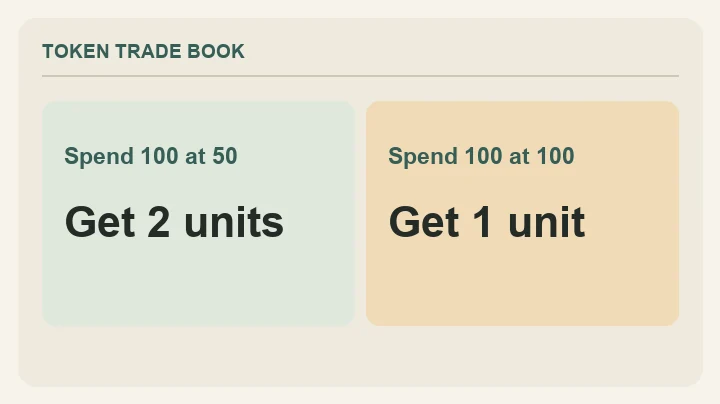
Work out the average from total units
Suppose two hypothetical purchases each spend 100 before fees. At 50 you buy two units; at 100 you buy one. Total expenditure of 200 divided by three units gives an average acquisition cost of about 66.67 per unit. It differs from the simple average of the two observed prices, which is 75.
Compare costs on the same budget
Under an identical total cash budget, regular purchases can incur more fixed fees and spreads than a single order. When evaluating two schedules, compare total units received, cash left unspent, charges and exposure over the full period. A platform may quote a higher all-in price for automatic conversions.
What the schedule changes
The mechanism changes the timing of entry and can reduce the need to choose a single purchase date. It also means some cash stays uninvested for longer. If an asset keeps falling, a lower average acquisition cost can coexist with a growing aggregate loss. Execution discipline and asset risk are separate questions.
Compare two schedules after charges
If each of two 100 purchases has a 1 fee deducted first, available cash is 99 each time. At 50 and 100 that buys 1.98 and 0.99 units. An all-in average uses the full 200 cash outlay divided by 2.97 units, about 67.34. This comparison assumes no further spread or charges.
Does dollar-cost averaging outperform a lump sum?
There is no universal result. The path of prices, spending schedule and fees determine the outcome. Neither approach guarantees a profit.
Educational material. Examples are hypothetical.