USDe vs USDT: Two dollar targets, different backing and exits
Ethena’s USDe and Tether’s USDT both aim to track the U.S. dollar. USDe uses a backing portfolio that can include hedged exposures and other strategies. USDT is issued by Tether against reserves it discloses. Compare how each token is backed, which network and token the recipient accepts, and what you can actually receive when you sell or redeem it.
| Question | USDe | USDT |
|---|---|---|
| Who sets the terms? | Ethena BVI for the USDe services described in its terms | Tether for USD₮ issuance and redemption services |
| What to inspect in the backing? | Exposure by strategy, hedges and counterparties alongside reserve assets | Dated reserve composition, valuations and related liabilities |
| Who can redeem directly? | Eligible onboarded Mint Users, for supported assets under the terms | Eligible verified customers under the terms, subject to minimums and fees |
| What determines the venue price? | Executable quotes and market depth for the specific pair and amount | Executable quotes and market depth for the specific pair and amount |
| Do the tokens alone entitle you to rewards? | Plain USDe terms say holders have no entitlement to reserve earnings | USDT is a token pegged to USD. Check any separately marketed reward service on its own terms. |
Ethena protocol overview · Ethena USDe terms · Tether’s reserve disclosure · Tether’s terms · Tether’s fees
What could break the two exits?
With USDe, ask how the portfolio handles hedge mismatch, funding changes, custody and counterparty stress. A well-matched hedge can limit immediate exposure to a market move while a derivatives or custody issue still limits access to profits or collateral. With USDT, ask how the reserve assets are valued and how liquid they are alongside the terms for accessing direct redemption. Both token prices can vary on trading venues, even if an issuer’s mechanism continues operating.
Worked example: same balance, two cash quotes
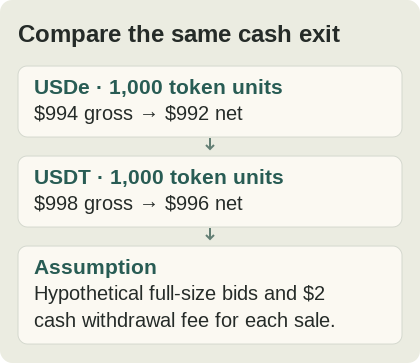
Suppose you hold 1,000 units, can sell either token to a usable USD balance, and can withdraw that balance for a $2 fee. An illustrative full-size bid of $0.994 for USDe gives $994 gross and $992 after the withdrawal fee. A $0.998 bid for USDT gives $998 gross and $996 after the same fee. These numbers are invented to show the calculation. Neither is a market forecast or a direct issuer redemption quote.
If a platform quotes only USDe/USDT, the rate is in USDT. Converting 1,000 USDe at 0.994 USDT yields 994 USDT before any pair fees. You still need a separately usable USDT/USD conversion and cash withdrawal to know the bank proceeds. If a recipient asks for USDT over a particular chain, sending USDe cannot substitute for that request.
For a trading decision, compare full-size executable quotes on platforms you can use. For a transfer, get the recipient’s exact asset and network. For a longer holding decision, read the current backing disclosures and think through what you could do if your usual venue paused withdrawals.
Read next: What is USDe? and What is USDT?.