What belongs in a trading plan you can actually follow?
A trading plan is a written decision rule for what qualifies, what you will do if it qualifies, and when you will stop. A useful plan makes it possible to review a losing trade without rewriting the rules to fit the outcome.
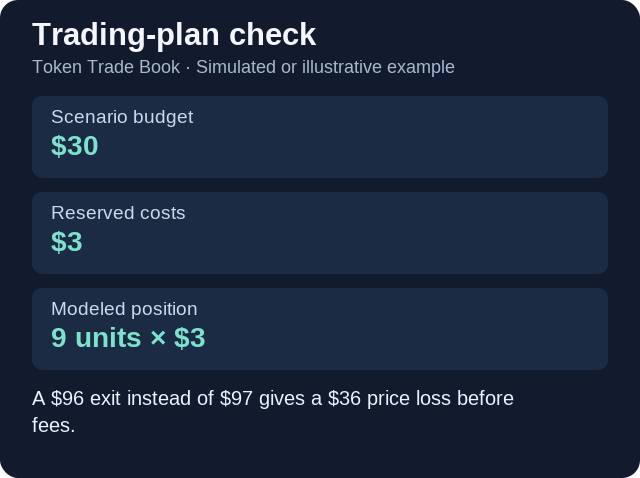
Fill in one page
| Decision | What you write |
|---|---|
| Scope | Product, hours, market conditions and whether the exercise uses paper money |
| Entry condition | A condition another person could identify from the same data |
| Invalidation | The price, event or time limit that makes your reason for the trade cease to apply |
| Size | Planned units, fees allowance and maximum scenario loss for the exercise |
| Execution | Instruction, reference price, treatment of partial fills, and cancel condition |
| Stop condition | When you pause the exercise and what evidence you need before resuming |
| Review | What you will save and when you will assess adherence |
A phrase such as “trade strong momentum” is hard to review. “Record a candidate after the 15-minute candle closes above the prior session high” can be checked. That specificity makes a hypothesis testable. It does not establish that the rule has an edge.
Work through a simulated plan
A setup in a practice account has a $100 hypothetical entry and a $97 invalidation price. Its planned price difference is $3 per unit. If the exercise uses a $30 scenario-loss cap and reserves $3 for costs, it allows nine units on that arithmetic. A $96 execution would make the price loss $36 before fees. The scenario cap depends on the assumed fill, so the plan must explain how to handle a gap or incomplete exit.
Write an execution instruction below the arithmetic. If the entry fills only four of nine units and the signal expires, cancel the open five units and account for the four you actually hold. If the order status is uncertain, observe the order history and current position before submitting another instruction. The order report is the evidence you need to reconcile the position.
Decide in advance how a session ends
A stopping rule can be based on loss, number of attempts, broken process, or missing information. For example, pause the paper session after the first position-size mismatch and reconcile the ledger before another test. Avoid changing a rule midway through a batch of examples. If you revise the plan, record the date and start a fresh version so your review does not combine incompatible rules.
Review decisions and outcomes in separate columns
Grade every trade against the rules known before entry. Then record fill, fees, result and any gap between the scenario and what occurred. A winning trade may violate the plan and a losing trade may follow it. Include the trades you passed on if you want to measure whether you apply the entry rule consistently.
The shortest useful record is a dated plan version, the evidence you saw, and a saved execution report. Use the position sizing guide to review scenario loss and order types to check how your price and cancellation instructions interact.