Crypto leverage calculator for a linear futures position
To calculate effective leverage, divide position notional by the equity or collateral you specify for the calculation. The denominator tells you whether you are measuring one position against its initial margin or your positions against the whole account. Record both the number and its denominator.
Open the interactive leverage calculator. Use one quote currency to compare entry notional, gross and after-fee P&L, and return on initial margin.
Calculate one linear position
Use a single quote currency for prices, margin and equity. Enter exposure in underlying units after applying the contract multiplier.
The model assumes fixed exposure until exit and equal percentage fees on each fill. It excludes funding, borrowing costs, forced liquidation, collateral revaluation, and inverse contracts. Use modeled fill prices to reflect hypothetical spread and slippage.
Calculate one linear position
| Input | Example |
|---|---|
| Units of underlying exposure | 0.5 |
| Price per unit | $20,000 |
| Initial margin assigned to the position | $2,000 |
| Total account equity | $5,000 |
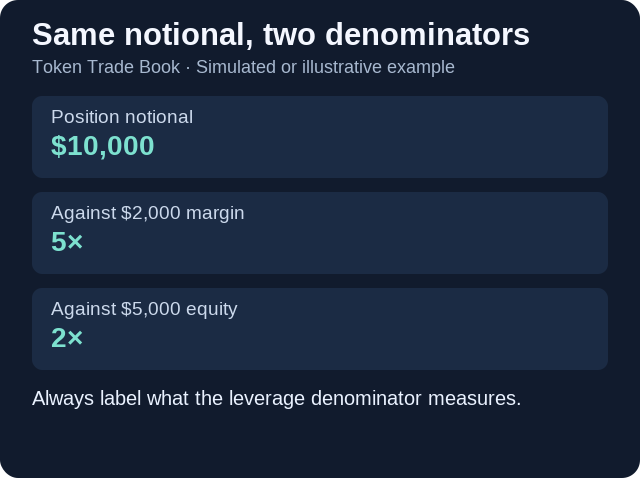
The initial notional is 0.5 × $20,000 = $10,000. Against the $2,000 margin assigned to the position, that is 5×. Against $5,000 of account equity, the same position’s notional is 2×. A two-sided account may need separate gross and net notional measures. A long on one product and a short on another can offset some risk without making both positions disappear.
Calculate the effect of a price change
For 0.5 units of linear exposure, a $400 rise in price creates $200 of gross P&L for a long and a $200 gross loss for a short. That is 2% of $10,000 original notional or 10% of $2,000 initial margin. The move, the dollar result and the measured return all use different units. Label them before comparing two setups.
If the same long loses $200, with no other changes a simplified mark-to-market at $19,600 would leave position notional at $9,800 and whole-account equity at $4,800. The resulting ratio is about 2.04× against account equity. Changing notional and changing equity can move the ratio even though that example held the same exposure quantity.
Use the reverse calculation carefully
With a specified $500 denominator and an illustrative 3× ratio, the implied notional is $1,500. At a $100 underlying price, that is 15 units of simplified linear exposure. Convert units to contracts using the actual multiplier, apply the permitted lot step, and check the revised notional. Product or venue constraints can include maintenance tiers, initial margin rules, leverage caps and permitted collateral. The simple ratio does not establish an eligible size for your account.
What this worksheet cannot tell you
Effective leverage is not a liquidation price. Liquidation depends on the maintenance requirement, valuation prices, collateral and chosen margin mode. A stop order also cannot guarantee exit at its trigger. If you are estimating exposure and scenario loss together, record notional, equity, price movement and cost assumptions in separate columns. Then consult the liquidation price guide and the position size calculator for their distinct inputs.