Why did auto-deleveraging close part of a profitable position?
Auto-deleveraging, or ADL, is a venue-defined mechanism that can reduce an open derivative position on the opposite side of a liquidation or deficit event. It can affect a position that was profitable and had margin remaining. The affected quantity, eligibility, priority and exit price depend on the venue’s rules.
Trace the event in the right order
- Positions on one side of the market encounter stress. A venue may liquidate some accounts according to its stated margin rules.
- Its liquidation and backstop process handles those positions under the product rules. Some venues invoke ADL only under defined shortfall or fund conditions. Check the actual trigger.
- If ADL applies, eligible opposing positions may be ranked or selected by the documented method. A venue may use unrealized P&L and leverage as inputs.
- An affected position reduces at a venue-defined event price. The trade and account history should show the reduced quantity or an ADL event type.
Hyperliquid, for example, documents an opposite-side ranking using unrealized P&L and leverage when the relevant value turns negative. Binance documents its own mechanism. A queue indicator is product-specific. Read it as eligibility or ranking under those rules, and check product documentation before interpreting it as probability.
Reconcile a simulated event
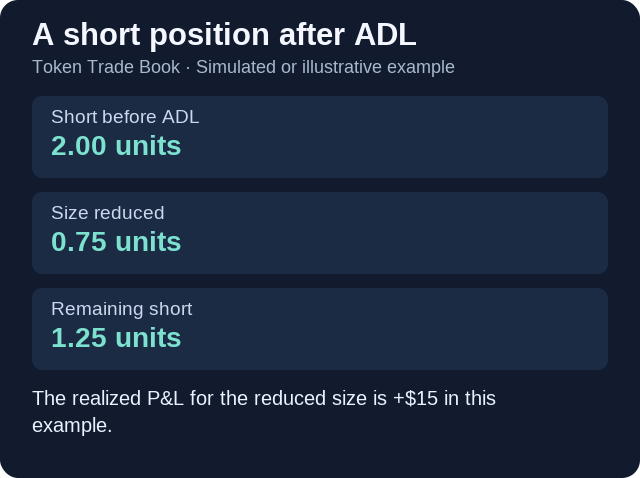
Suppose a short has two units at $100 and an ADL event closes 0.75 unit at $80. It now has 1.25 units of exposure. The affected quantity realizes $15 of gross trade P&L under a linear formula. If it opened as a hedge against two units of long exposure elsewhere, 0.75 unit of that hedge is now absent. A profitable event can create a new mismatch.
Do not use the last chart price to reconstruct the ADL receipt. Compare event timestamp, size and event price from the venue history. Then check your current position, any commissions or settlement entries, and any outstanding instructions attached to the prior position. Each platform can handle open instructions differently after a reduction.
Which account event am I looking at?
| Event | Core question |
|---|---|
| Your own liquidation | Did the venue intervene because your side breached a margin condition? |
| Opposing position reduced through ADL | Was your position selected under the venue’s deficit/backstop rules? |
| Your voluntary close | Does the order history show a user or strategy order, and which quantity filled? |
Consult the event code or account ledger before attributing a closure to any of these mechanisms. The liquidation guide covers the account-level trigger separately.