What is scalp trading, and can a small price move cover the costs?
Scalping means trying to capture small moves on a very short holding period, typically seconds to minutes. The size of the move matters only after you compare the prices you can actually trade and the fees on both fills.
Replay a ten-cent rise that loses money
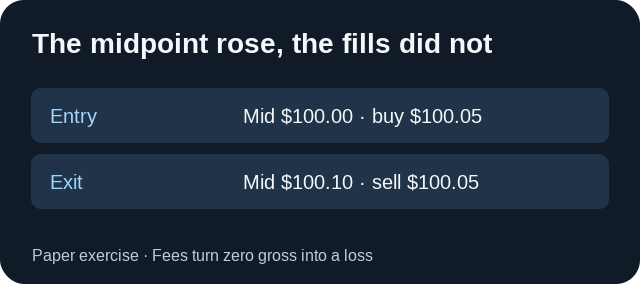
Consider a paper trade for one unit, using top-of-book quotes with enough visible size. Assume no quote changes during each execution and a hypothetical 0.05% fee on each fill.
| Snapshot | Best bid | Best ask | Paper fill |
|---|---|---|---|
| Entry | $99.95 | $100.05 | Buy at $100.05 |
| Exit | $100.05 | $100.15 | Sell at $100.05 |
The midpoint climbs from $100.00 to $100.10, but the fills occur at the same price. Gross P&L is zero. Fees total $0.10005, producing a $0.10005 loss before rounding.
With these fees and a $100.05 entry, the break-even sale price is $100.05 × 1.0005 ÷ 0.9995, about $100.1501 before price increments and rounding. A quote on a screen is only the first step. Trading more than the displayed quantity can require worse prices, while displayed quantity can disappear before the order arrives.
What changes with a limit order?
A limit order puts a boundary on the acceptable price. If it rests in the queue, the market can move without filling it. If it crosses the book, an immediately matched part can receive taker treatment. Use the maker and taker receipt to check rates by fill. Do not assume a passive order will fill simply because a candle reached its price.
Try it
Replay ten two-sided quotes on one spot pair. For each paper round trip, record the bid, ask, displayed size, order side, modeled fill and fee. Mark ambiguous fills separately. Compare gross P&L with net P&L and count how many trades change sign. That tests the cost model, without claiming a trading edge.
Sources: Coinbase Exchange order book format, Coinbase Advanced fee mechanics.