What is a perp DEX, and what can fail between your wallet and the trade?
A perp DEX is a venue or protocol for trading perpetual derivatives that uses blockchain infrastructure for some or all of its components. You might authorize actions with your wallet and still rely on a matching system, oracle, bridge or settlement mechanism. Evaluate the implementation behind each step.
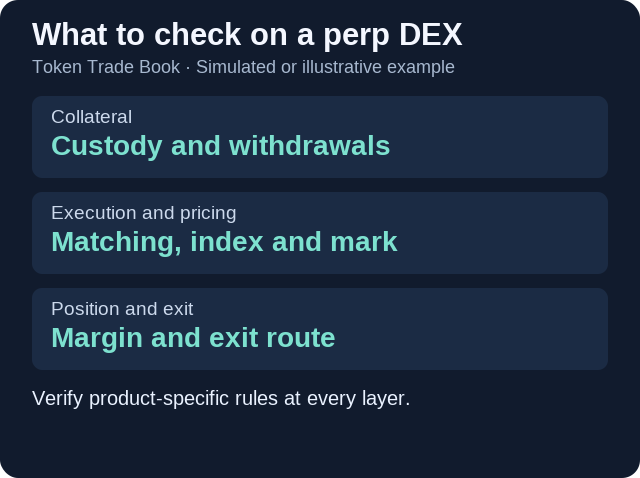
Trace the position through five layers
| Layer | What to verify |
|---|---|
| Collateral | Where funds are held, which asset backs margin, and how deposits and withdrawals work |
| Order execution | Where orders are recorded and matched, what happens if a sequencer, validator or front end stops responding |
| Price reference | Which feeds supply the index and mark and which mark controls liquidation or conditional orders |
| Position accounting | Funding, fees, collateral valuation, margin model and bankruptcy/backstop rules |
| Exit route | How to reduce exposure, withdraw collateral and confirm final state if the usual interface is unavailable |
Protocols can use onchain order books, separate matching components or liquidity-pool designs. Two venues advertised as decentralized may give you different ways to verify fills and recover access. Make your comparison at the layer level. A label tells you little about which component can interrupt a trade.
A simulated interruption
Assume a wallet authorized collateral and a small perpetual position. Its web interface becomes unreachable while the position remains active. You now have three questions. Is the position still active in protocol state? Is there another documented route to submit a reduce instruction? What feed continues to drive maintenance requirements while the interface is down?
An unavailable interface and an unavailable matching layer are different incidents. A transaction signed in your wallet is also a different status from posted, matched, finalized or withdrawable. Verify each step from the venue's reference documentation or independent protocol state where available. Avoid assuming that closing a browser window cancels an order.
Compare evidence before comparing volume
Volume, open interest and fees help describe activity. They do not reveal bridge controls, collateral recovery, availability or which oracle drives margin. For example, Hyperliquid documents its own oracle and market mark roles. Read the relevant protocol’s materials rather than copying those rules to another platform.
If you are trying to understand the contract first, read the perpetual futures guide. If you are comparing two protocols, record product and chain, document date, and what you can verify for each layer. Leave unknown fields open rather than treating them as equivalent.