Order block: why different traders draw different boxes
An order block in retail price-action terminology is a zone drawn around a selected candle before a move. One bullish convention marks the last down candle before a move that closes above an earlier swing high. Other conventions require a displacement threshold or use different zone boundaries. State your convention before comparing charts.
Should the box cover the candle body or the wicks?
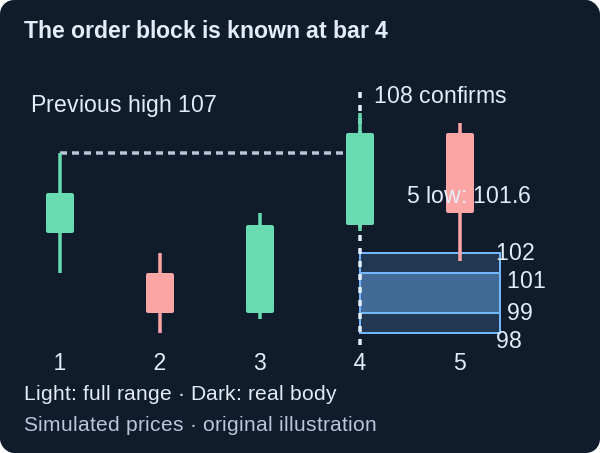
In a simulated example, the candidate candle opens at 101, closes at 99, and ranges from 98 to 102. After a move that closes above the earlier swing high of 107, it qualifies under the chosen rule. A body-only zone is 99–101, while a full-range zone is 98–102. A later low at 101.6 touches the full range and stays outside the body. Two readers can inspect the same data and log different touches while following different rules.
Worked example with simulated prices
A complete rule names the timeframe, swing test, confirmation close, candle selection, zone boundaries and expiry or invalidation. If several down candles precede the move, define which one qualifies. Record the time of the break before counting retests. Labeling the zone before that confirmation would introduce future information into a test.
| Candle | Open | High | Low | Close |
|---|---|---|---|---|
| 1 | 103 | 107 | 101 | 105 |
| 2 | 101 | 102 | 98 | 99 |
| 3 | 99 | 104 | 98.7 | 103.4 |
| 4 | 103.4 | 109 | 103.1 | 108 |
| 5 | 108 | 108.5 | 101.6 | 104 |
Check your interpretation
If the candidate candle’s full range is 98–102 and the rule invalidates only on a close below 98, a later low of 97.8 and close of 99 keeps the zone active. A low-based rule would invalidate it on that same bar.
What the chart can establish
An order block inferred from candles is a chart annotation. Individual orders, owners and queue positions require separate data. A larger candle or a larger follow-through does not identify an institutional participant. If testing the claim, log failed candidates as well as successful revisits and choose a non-pattern baseline.
Compare price action trading, fair value gaps and actual order-book data.
Sources
- OrderBlock’s trading terminology guide — One practitioner’s last-opposite-candle convention.
- Coinbase Exchange candle data reference documents the aggregate price fields used to build candles.