Crypto weekend trading: how to check liquidity before an order
Crypto spot trading generally continues on weekends. Execution quality can change even when the displayed spread looks familiar. On the same pair and venue, check how much size is available at individual prices and whether that size can cover the order you are modeling.
Replay two books with the same best quotes
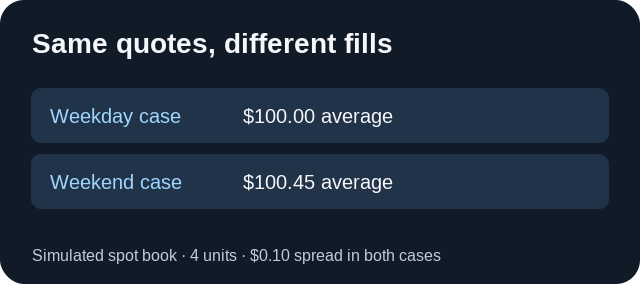
In this simulated spot example, both snapshots show a $99.90 bid and a $100.00 ask. Assume you paper-buy four units, each book stays fixed during the fill, and fees are excluded.
| Snapshot | Ask size at $100 | Next ask | Average fill for four units |
|---|---|---|---|
| Weekday | 5 units | No second level needed | $100.00 |
| Weekend | 1 unit | 3 units at $100.60 | $100.45 |
The quoted spread is $0.10 in both snapshots. The weekend order pays $1.80 more in total because three units execute $0.60 above the initial ask. The labels describe a teaching setup. They do not establish a weekday-versus-weekend market average.
Track what changed
Volatility measures how prices move. Volume measures how much traded over a window. Depth measures displayed quantities available at different prices at a moment. The three can diverge. One large print increases measured volume, and a new snapshot can show less depth after that execution.
For a perpetual, separately check funding time, contract liquidity, trigger or mark references, and liquidation rules. Check venue status before assuming a transfer, cash deposit or order action is available merely because the spot chart is moving. Also see crypto market timings.
Try it
Choose one pair and venue. Record snapshots at the same UTC hour on several weekdays and weekends. Use the same side and size to compute each modeled average fill. Report median and worst observed cost, note any sparse sample, and keep your conclusion specific to that period, pair and venue.
Sources: Coinbase Exchange order-book format, Kaiko's original liquidity case study, Coinbase service status.