What is breakout trading in crypto?
A breakout is a move outside a defined range or price boundary. A test needs to say what confirms the move and what price would first be available after that confirmation.
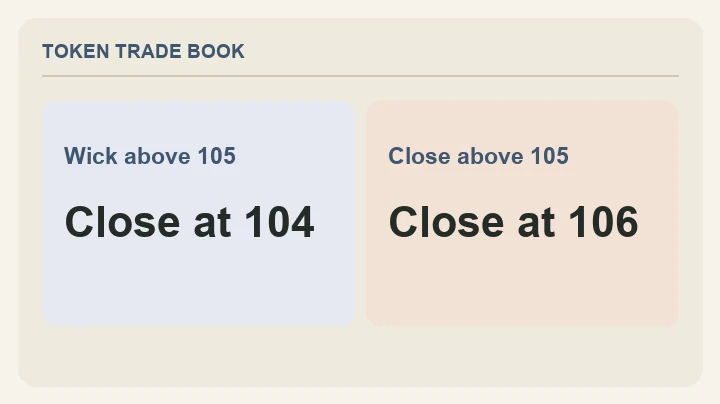
Choose the boundary before the move
Suppose a range repeatedly holds between 95 and 105. Your example rule requires a candle close above 105. A bar with a high of 106 and a close of 104 does not qualify. A close at 106 does. Keeping the rule fixed prevents a later winning move from changing what you call a valid signal.
Model the earliest possible fill
If your condition depends on the close, you cannot assume a fill earlier in that bar at 105. Check the first executable price after confirmation, any spread and plausible slippage. A move that quickly returns below 105 can still be a valid breakout under your original definition and a failed outcome under the stated exit rule.
Keep false breaks in the record
Record the exchange, interval, boundary, trigger and next observable price for every case. Distinguish a touch, a close and a sustained move as separate variants. Compare them with a simple baseline and reserve independent data. Avoid conclusions based on a handful of charts selected after they became memorable.
Record whether two similar bars both count
In a close-above-105 example, a close of 105 exactly only qualifies if your rule explicitly includes equality. A close of 105.01 qualifies under a strict “above” rule even if a later bar closes back inside the range. Build the comparison into the test so chart reading and execution assumptions are reproducible.
Does high volume confirm the move?
A volume increase can be useful context, but it does not guarantee continuation. Check whether the comparison window, venue and liquidity match the hypothesis.
Educational material. Examples are hypothetical.