Bollinger Bands strategy: compare a squeeze and a re-entry rule
Bollinger Bands place volatility bands around a moving average. A common setting uses a 20-period simple average of closes plus or minus two standard deviations. As recent closes disperse, the bands typically widen. A price moving outside a band can be part of a sustained trend or a brief move followed by a return.
What is the difference between a squeeze breakout and a return inside the band?
In a defined squeeze approach, mark bars when band width relative to the middle band is below a threshold. Then log the first close outside either band and specify when the setup expires. In a separate range approach, record a close back inside after a prior close outside, using an independent, preset definition of a range. The two approaches act on different events.
Worked example with simulated prices
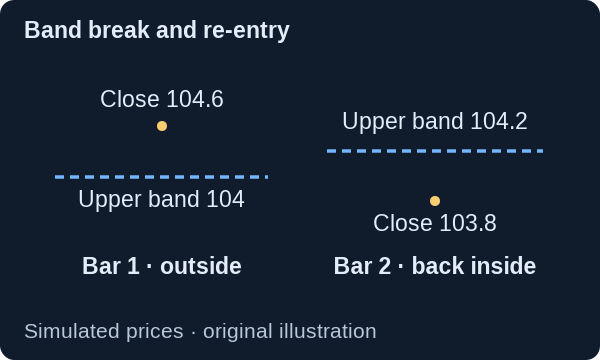
Suppose the 20-close mean is 100 and its standard deviation is 2. The bands are 96 and 104, and relative width is 8 divided by 100, or 8%. If a past bar’s relative width passed a prespecified squeeze test, today’s close of 104.6 above today’s 104 upper band could count as a break. If the next bar closes at 103.8 and its recalculated upper band is 104.2, that next close is back inside. A continuing sequence of closes near the band would look different.
Check your interpretation
With the same mean of 100, change the standard deviation from 2 to 3. The bands become 94 and 106, and width increases to 12%. A close of 104.6 would now stay inside. Fix the standard deviation convention whenever implementations are compared.
What the chart can establish
Fix the price series, averaging window, standard-deviation convention and signal timestamp before testing. If a rule waits for a close, use an attainable later execution assumption. Compare the rules on separate, untouched data, net of spread, slippage and fees. A band touch alone estimates neither reversal probability nor achievable returns.
Review moving averages, range volatility and slippage.
Sources
- John Bollinger’s published band rules — Original methodology and the distinction between a tag and a trading instruction.